Light and Its Properties
Light is a form of electromagnetic radiation that is visible to the human eye. It exhibits both wave-like and particle-like properties, a duality that forms the foundation of physical optics.
Fundamental Properties of Light
Light has several key properties that define its behavior:
- Wavelength: The distance between successive crests of a wave, typically measured in nanometers (nm) for visible light.
- Frequency: The number of wave cycles that pass a given point per unit time, measured in Hertz (Hz).
- Speed: In a vacuum, light travels at approximately 299,792 km/s (often rounded to 3 × 10⁸ m/s).
- Intensity: The amount of energy the wave carries per unit area per unit time.
- Polarization: The orientation of the electric field vector's oscillation.
Example: Rainbow Formation
A rainbow demonstrates several properties of light simultaneously. When sunlight enters a water droplet, it is refracted (bent), then reflected off the back of the droplet, and refracted again as it exits. This process separates the light into its component wavelengths (colors) due to dispersion - the property that different wavelengths of light refract by slightly different amounts.
Electromagnetic Wave Nature
Light is an electromagnetic wave consisting of oscillating electric and magnetic fields that propagate through space perpendicular to each other and to the direction of propagation.


Characteristics of EM Waves
The electromagnetic spectrum encompasses all possible frequencies of electromagnetic radiation, from radio waves to gamma rays. Visible light occupies only a small portion of this spectrum, roughly between 380 nm (violet) and 750 nm (red).
Interactive: EM Spectrum Explorer
Visible light: 380-750 nm
Particle Nature of Light
While light exhibits wave-like properties, it also demonstrates particle-like behavior. These particles are called photons, which are quanta (discrete packets) of electromagnetic energy.
Photoelectric Effect
The photoelectric effect, explained by Albert Einstein, demonstrates the particle nature of light. When light shines on a metal surface, electrons are emitted only if the light's frequency exceeds a certain threshold, regardless of intensity.
Example: Solar Panels
Solar panels operate based on the photoelectric effect. Photons from sunlight strike the semiconductor material in the panel, knocking electrons loose and creating an electric current. The energy of each photon must exceed the material's work function (minimum energy needed to free an electron) for the effect to occur.
Interactive: Photoelectric Effect Simulation
Current: 0 mA (Frequency below threshold)
Visible Light and the Eye
The human eye is a remarkable detector optimized for the visible spectrum. It contains specialized photoreceptor cells called rods and cones that convert light into neural signals.
Eye Anatomy and Function
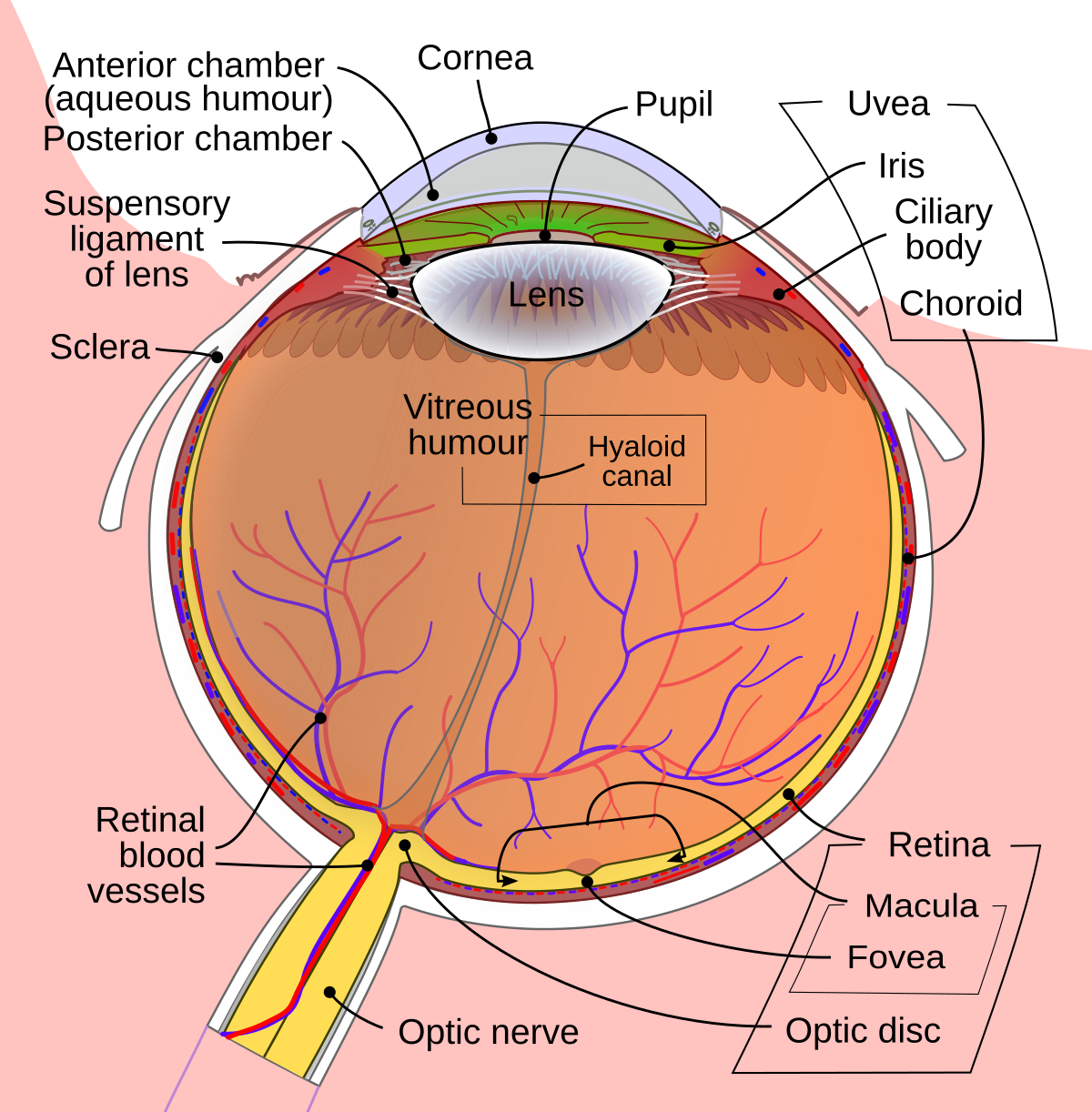
Key components in light detection:
- Cornea: The transparent front part that refracts light
- Lens: Further refracts light to focus it on the retina
- Retina: Contains photoreceptor cells (rods for low light, cones for color)
- Fovea: Area of highest visual acuity with dense cone cells
Light Damage to the Eye and Protection
While light enables vision, certain types of light can damage ocular tissues, particularly with prolonged exposure.
Types of Light Damage
- UV Radiation: Can cause photokeratitis (corneal sunburn) and contribute to cataracts
- Blue Light: May contribute to retinal damage and age-related macular degeneration
- Infrared Radiation: Can cause thermal damage to ocular tissues
- Laser Light: Can cause immediate, severe retinal burns
Example: Welder's Flash
Welder's flash (photokeratitis) occurs when intense UV radiation from welding burns the cornea. Symptoms include pain, redness, and temporary vision loss, typically appearing several hours after exposure. This demonstrates why welders must use proper eye protection that blocks UV radiation.
Protective Measures
Various methods exist to protect eyes from harmful light:
- Sunglasses with UV protection
- Specialized safety goggles for occupational hazards
- Blue light filters for digital screens
- Laser safety glasses tuned to specific wavelengths
Phenomena Based on Wave Optics
Wave optics explains many phenomena that cannot be understood using geometric (ray) optics alone. These include interference, diffraction, and polarization effects.
Key Wave Phenomena
- Interference: Superposition of waves leading to reinforcement or cancellation
- Diffraction: Bending of waves around obstacles or through openings
- Polarization: Orientation of wave oscillations in a particular direction
Example: Soap Bubbles
The colorful patterns on soap bubbles result from thin-film interference. Light reflecting off the outer and inner surfaces of the soap film interfere with each other. Depending on the film's thickness and the light's wavelength, certain colors are reinforced while others are canceled out, creating the shifting rainbow patterns we observe.
Interference
Interference occurs when two or more light waves superpose to form a resultant wave of greater, lower, or the same amplitude.
Types of Interference
- varructive Interference: When waves are in phase, their amplitudes add
- Destructive Interference: When waves are out of phase, their amplitudes subtract
Interactive: Wave Interference
Clinical Significance of Interference
Interference phenomena have several medical applications:
- Optical Coherence Tomography (OCT): Uses interference of light to create cross-sectional images of retinal layers
- Anti-reflective Coatings: On eyeglasses and camera lenses reduce glare through destructive interference
- Interferometry: Used in precise measurements of corneal topography
Diffraction
Diffraction refers to the bending of light waves around obstacles or through openings, resulting in characteristic patterns.
Types of Diffraction
- Fresnel Diffraction: Occurs when either the source or the screen is close to the diffracting aperture
- Fraunhofer Diffraction: Occurs when both source and screen are effectively at infinite distance from the aperture
Interactive: Diffraction Patterns
Applied Aspects of Diffraction
Diffraction has numerous practical applications:
- Spectroscopy: Diffraction gratings separate light into its component wavelengths
- X-ray Crystallography: Uses diffraction patterns to determine atomic structure
- CD/DVD Reading: Laser light diffracts off the microscopic pits to read data
- Holography: Relies on diffraction to revarruct 3D images
Polarization
Polarization refers to the orientation of the electric field vector in an electromagnetic wave. Natural light is typically unpolarized, with random orientations.
Production of Polarized Light
Several methods exist to produce polarized light:
- Polarizing Filters: Absorb light oscillating in one direction while transmitting the perpendicular component
- Reflection: Light reflected off non-metallic surfaces becomes partially polarized
- Birefringent Materials: Split light into two polarized components with different refractive indices
- Scattering: Skylight becomes polarized due to atmospheric scattering
Example: Polarized Sunglasses
Polarized sunglasses reduce glare by blocking horizontally polarized light that dominates reflections from horizontal surfaces like water or roads. The polarizing filter in the glasses is oriented vertically, allowing only vertically polarized light to pass through, significantly reducing reflected glare.
Birefringence
Birefringence (double refraction) occurs in anisotropic materials where light splits into two rays with different polarizations and speeds.

Applications of Birefringence
- Polarization Microscopy: Used in geology and biology to study crystalline structures
- Liquid Crystal Displays (LCDs): Use electrically controlled birefringence to manipulate light
- Stress Analysis: Transparent models of objects under stress viewed between polarizers reveal stress patterns
- Optical Isolators: Prevent back-reflected light in laser systems
Phenomena Based on Quantum Optics
Quantum optics studies phenomena where light exhibits its particle nature or interacts with matter at quantum levels.
Key Quantum Optical Phenomena
- Photon Statistics: Behavior of photons in different states (coherent, thermal, etc.)
- Quantum Entanglement: Non-classical correlations between photons
- Squeezed Light: Light with reduced quantum noise in one observable at the expense of increased noise in another
- Quantum Cryptography: Using quantum properties for secure communication
Example: Quantum Dots
Quantum dots are nanoscale semiconductor particles that exhibit quantum optical properties. Their emission color depends on size due to quantum confinement effects. Applications include biological imaging (where different-sized dots can tag different cellular components) and quantum dot displays in televisions that offer purer colors than traditional LCDs.
Transmission and Absorption of Light
When light interacts with matter, it can be transmitted, absorbed, or scattered. The specific interaction depends on the material's properties and the light's wavelength.
Transmission Mechanisms
- Transparent Materials: Allow light to pass with minimal scattering (e.g., glass)
- Translucent Materials: Scatter light while transmitting it (e.g., frosted glass)
- Opaque Materials: Absorb or reflect most incident light (e.g., metals)
Interactive: Light Transmission Through Materials
Transmission: 92% (Glass transmits most visible light)
Scattering of Light
Scattering occurs when light is deflected from its original path by localized non-uniformities in the medium through which it passes.
Mechanisms of Light Scattering
- Rayleigh Scattering: Scattering by particles much smaller than the wavelength (responsible for blue sky)
- Mie Scattering: Scattering by particles comparable to or larger than the wavelength (responsible for white clouds)
- Raman Scattering: Inelastic scattering where light changes frequency due to molecular vibrations
- Brillouin Scattering: Scattering from acoustic phonons in a medium
Example: Why is the Sky Blue?
The blue color of the sky results from Rayleigh scattering. Shorter wavelengths (blue/violet) scatter more efficiently than longer wavelengths (red/orange) when sunlight interacts with atmospheric molecules. At sunset, light passes through more atmosphere, scattering the blue light away and leaving the longer wavelengths that create red and orange hues.